
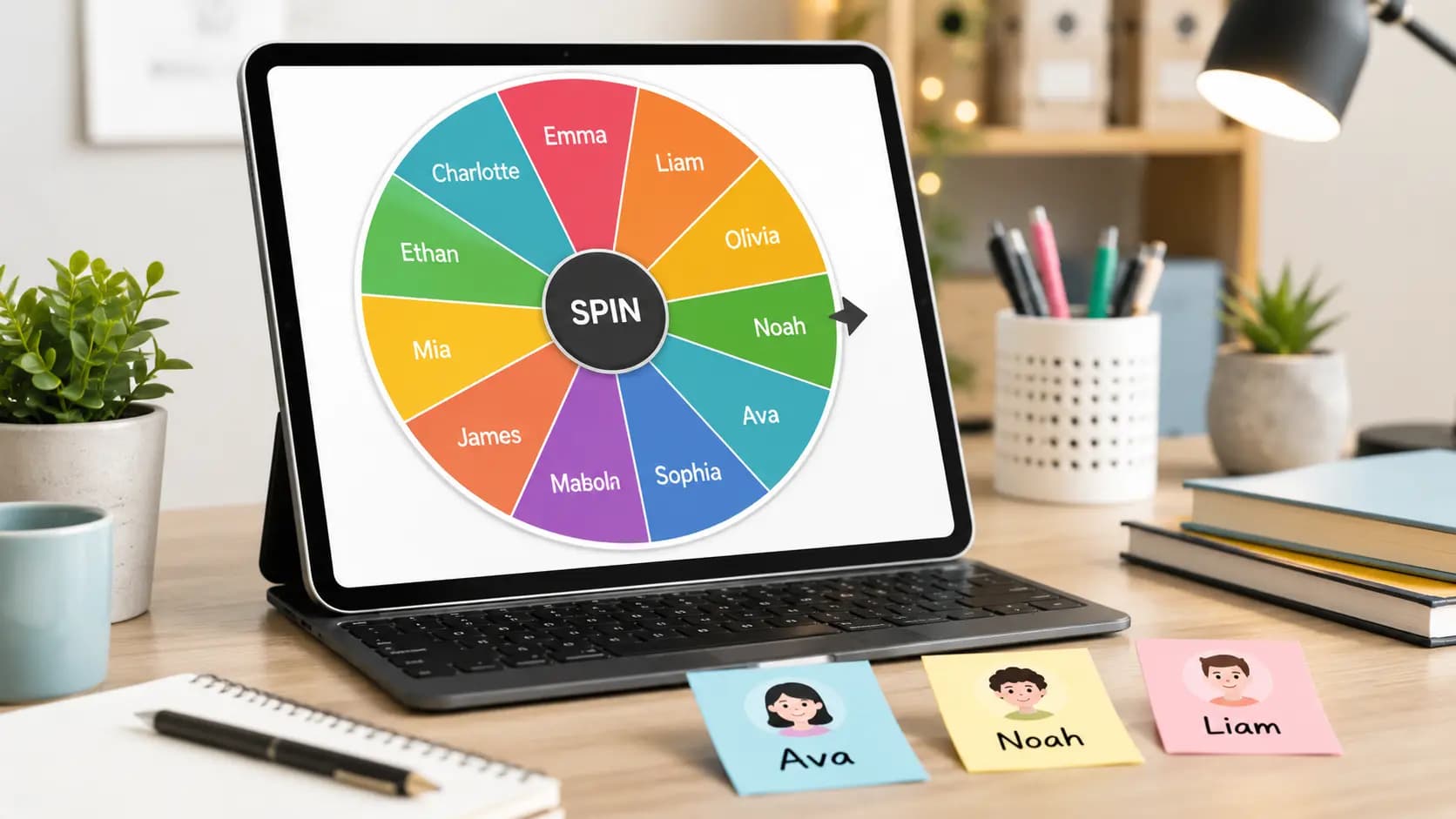
How to Create a Free Online Name Spinner
Choosing a person at random seems simple... until you're faced with a list of twenty, fifty, or even a hundred names.
Who starts the game? Who presents first? Who gets to perform a task? Who wins a small prize?
You could write all the names on slips of paper, fold them, put them in a bag, and draw one at random. That works, of course. But there's a much quicker, more visual, and enjoyable way: using an online name spinner.
With SorteosUp's name spinner, you can enter a list of participants, spin the wheel, and choose a name at random in just seconds.
No papers. No calculations. No disputes.
You add the names, spin the wheel, and let chance decide.
While we usually think of a random name spinner for small giveaways, it can actually be used in countless situations: schools, games, businesses, family gatherings, sports activities, events, group dynamics, or simply to resolve small everyday decisions.
In this guide, we explain how to create a name spinner, how to use it, and some practical ideas to make the most of it.
What is a Name Spinner?
A name spinner is a tool that allows you to input different people, participants, or options and then randomly select one of them.
Its operation is reminiscent of a traditional roulette wheel.
Each participant is represented on the wheel, and when the spinning starts, the selection moves between the different options until it finally stops on one.
The result is immediate and very easy to understand.
This is why a name spinner is especially interesting when we want to make a selection in front of several people.
It’s not just a result that suddenly appears on a screen.
You can see how the wheel spins.
You can watch it slow down.
And you can check where it stops.
That little moment of uncertainty turns a simple decision into something much more entertaining.
How to Create a Name Spinner Step by Step
Creating your own random name spinner is very simple.
You just need to prepare your list of participants and use a tool to make the selection.
1. Prepare the List of Participants
First, decide who will be participating.
For example:
- Laura
- Mark
- Anna
- Charles
- Lucy
- James
- Martha
- Paul
You can use names, surnames, nicknames, or any other identifier that allows each participant to be easily recognized.
If there are two people with the same name, it’s advisable to differentiate them.
For instance:
- Laura G.
- Laura M.
This seems like a minor detail, but it will prevent confusion when the spinner selects the result.
2. Open SorteosUp's Name Spinner
The next step is to go to our random name spinner.
From there, you can prepare the selection directly from your browser.
The idea is simple: input the participants and use the spinner to choose a name randomly.
You don’t need to prepare papers or use a spreadsheet for a straightforward choice.
3. Enter All Names
Add the participants you want to include in the selection.
Before starting, take a few seconds to review the list.
Check especially that:
- No one is missing;
- No participant accidentally appears twice;
- The names can be easily identified;
- Only those who are actually participating are listed.
A quick review before starting can save you from having to repeat the selection later.
4. Spin the Wheel
With all names prepared, the fun part begins.
Spin the online name spinner.
The tool will start moving between the different participants until it finally stops on one of them.
That will be the selected name.
This visual component is precisely one of the main differences between using a spinner and simply using a random number generator.
You don’t just get a result.
You can see how the selection is made.
And when several people are watching the screen, the experience becomes much more entertaining.
5. Use the Result
Once the spinner stops, you'll have the selected person.
Depending on what you’re doing, you can use that result directly or run another round.
For example, you could use several consecutive selections to establish the order in which participants perform an activity.
What is a Random Name Spinner Used For?
A random name spinner can be used in many more situations than you might think.
Here are some of the most common ones.
Choosing a Winner at Random
This is probably one of its most obvious uses.
If you have a list of participants and need to choose someone at random, you can input all their names and let the spinner make the selection.
It can be useful for:
- Small contests;
- Games among friends;
- Family activities;
- Internal promotions;
- Events;
- Group dynamics;
- Small prizes.
For promotional giveaways with many participants, specific conditions, or rules, it’s better to use a dedicated tool.
For example, if you already have a list of participants, you can use the manual giveaway tool by SorteosUp.
But when you simply need to answer a question like “Who gets picked?”, a spinner can be a much quicker solution.
Using a Name Spinner in Class
The name spinner for students can become a very useful resource for teachers.
Imagine a class where only a few students always raise their hands.
Instead of choosing directly who responds, you can input all the class names and use a spinner.
For example:
“Let’s see who explains the next exercise.”
You spin the wheel.
It starts slowing down.
And a name appears.
This small component of uncertainty can make certain activities much more dynamic.
A spinner for teachers can also be used to:
- Choose who goes to the board;
- Establish turns;
- Select responsibilities;
- Decide who starts a presentation;
- Distribute activities;
- Select participants for a game;
- Ask random questions;
- Create group dynamics.
Plus, if you project the spinner on a screen, the whole class can see how the selection is made.
Choosing Who Starts a Game
Surely you've experienced a similar situation:
—I'll go first. —No, I got here first. —Let’s play rock, paper, scissors.
There’s a simpler solution.
Input all players' names into a spinner to choose people and let chance decide.
It can be used for:
- Board games;
- Video games;
- Family games;
- Sports activities;
- Contests;
- Parties;
- Get-togethers.
And it also adds a little element of excitement before starting.
Distributing Tasks Randomly
You can also use a random people spinner to distribute tasks.
Imagine a group of five colleagues and several similar tasks that need to be distributed.
Instead of wasting time negotiating who goes first, you can use a random selection to establish the order.
For example:
- First person selected.
- Second person selected.
- Third person selected.
- Fourth person selected.
- Fifth person selected.
This way, you reduce discussions and turn the choice into a neutral process.
It can work especially well for simple tasks where all participants have the same conditions.
Choosing Who Presents First
There’s almost always a question that arises when several people need to present something:
“Who starts?”
And usually, no one wants to do it.
A participant spinner allows you to resolve it in seconds.
You can show it on a screen, input all the names, and make the selection in front of the group.
It’s especially useful in:
- Schools;
- Colleges;
- Universities;
- Training courses;
- Business meetings;
- Workshops;
- Events.
The rule can be as simple as:
The name that comes up first begins.
Problem solved.
Creating Random Pairs or Groups
A spinner can also be part of a dynamic for organizing groups.
For example, you can start selecting names and distributing them alternately among different teams.
However, if what you really need is to automatically pair all participants, there’s a more specific tool.
You can use our random pair generator, which is designed to create pairs at random from a list of people.
The difference is simple:
- The name spinner is ideal for selecting one person.
- The random pair generator is better when you want to pair several participants automatically.
Using the right tool will save you a lot of time.
Name Spinner for Family Gatherings
Family gatherings are another perfect scenario for using a spinner.
Who cuts the cake?
Who starts the game?
Who chooses the movie?
Who unwraps their gift first?
Who starts karaoke?
We could argue for several minutes.
Or we could let the spinner decide.
Often, the fun lies not just in knowing the result, but in watching the spinner turn among all the names while each participant waits for their own to appear—or not appear.
Name Spinner for Businesses
An online random name spinner can also be useful within a company.
Of course, we’re not talking about using chance to make important decisions.
But it can be handy in certain informal dynamics:
- Deciding the order of a presentation;
- Creating turns for an activity;
- Choosing participants for a corporate game;
- Selecting volunteers among several people;
- Energizing meetings;
- Organizing team-building activities.
Turning a small decision into a visual dynamic can even help break the ice in certain meetings.
Why Use a Spinner Instead of Drawing Papers?
The traditional method works.
You write each name.
You cut the papers.
You fold them.
You find a container.
You mix them.
And someone draws one.
But using a digital name spinner has some obvious advantages.
It’s Much Quicker
You don’t need to prepare any materials in advance.
If you already have the participant list, you can make a selection almost instantly.
It’s More Visual
Seeing a spinner turn adds tension before knowing the result.
And let’s face it: part of the fun is precisely there.
When it starts slowing down and moves slowly past several names, everyone watches the screen trying to guess where it will stop.
It’s Easy to Modify
If someone joins the group, just add them.
If someone ultimately doesn’t participate, you can remove them from the list.
You don’t have to prepare all the papers again.
You Can Use It from Different Devices
An online spinner can be used from a computer, mobile phone, or tablet with internet access.
This is especially convenient for impromptu activities.
Name Spinner for Large Groups
The more participants there are, the more sense it makes to use a digital tool.
With four people, writing four papers is simple.
With twenty, it starts to become less convenient.
With fifty, much less so.
And if you have even more participants, an online name spinner greatly simplifies the process.
That’s why it can be especially useful for:
- Schools;
- Academies;
- Universities;
- Associations;
- Businesses;
- Sports clubs;
- Events;
- Online communities;
- Leisure activities.
You simply prepare the list and make the selection.
Is a Name Spinner Really Random?
The goal of a random name spinner is to select one of the participants entered without you having to manually decide who gets chosen.
That’s where much of its usefulness lies.
Instead of pointing directly at someone, you delegate the choice to the tool.
When you use the spinner in front of several people, moreover, everyone can see how the selection is made.
For games, educational activities, informal dynamics, or small decisions, it’s a convenient way to select people at random.
Difference Between a Name Spinner and an Online Raffle
While both systems can make random selections, they don’t serve exactly the same purpose.
An online name spinner is mainly designed for quick decisions.
For example:
- Who starts?
- Which student responds?
- Who presents first?
- Who wins this small prize?
- Who gets picked?
A specific system for conducting raffles may have additional features related to participants, rules, winners, substitutes, or certificates.
That’s why SorteosUp offers different tools depending on the type of selection you want to make.
If you simply want to input names and pick one, use the spinner.
If you need to organize a more complete raffle process, you can check our raffle tools.
Tips for Using a Name Spinner Correctly
While using a spinner is very straightforward, it’s wise to follow some recommendations.
Check the Participants
Ensure that all individuals are included and that no name appears duplicated by mistake.
Differentiate Repeated Names
If two Charles, two Lauras, or two Marthas are participating, use initials, surnames, or nicknames.
Decide the Rules Before Spinning
This point is especially important.
Can a selected person appear again?
Is the name eliminated after coming up?
Will there be a single selection or multiple?
The rules should be clear before knowing the result, not after.
This avoids the classic:
“That doesn’t count; we need to do it again.”
Make the Selection in Front of Participants
Whenever possible, showing the spinner adds transparency and makes the dynamic more entertaining.
Frequently Asked Questions about the Name Spinner
How do I choose a name at random?
One of the simplest ways is to use an online name spinner. Input all participants, start the spinner, and wait for it to stop on one of them.
Can I create a spinner with my own names?
Yes. The idea of this type of tool is precisely to allow you to input your own list of participants to then make a random selection among the names.
What can I use a name spinner for?
You can use it for games, classes, meetings, events, family activities, small contests, presentations, distributing turns, or any situation where you need to choose someone at random.
Can I use a spinner for students?
Yes. A name spinner for class can be used to select who answers a question, who goes to the board, who starts a presentation, or who participates in a specific activity.
What’s the difference between a spinner and a pair generator?
The spinner typically selects one person from several options. A pair generator is designed to automatically match participants in pairs. If that’s your goal, you can use the random pair generator by SorteosUp.
Can I use a spinner for a raffle?
For a simple selection among several names, it can be practical. If you need to manage a raffle with more participants or a more comprehensive process, it’s advisable to use a specific raffle tool.
Try SorteosUp's Name Spinner
You can spend five minutes discussing who goes first.
You can prepare twenty different slips of paper.
Or you can let a spinner decide in seconds.
With the online name spinner by SorteosUp, you can input your participants and perform a random name selection quickly, visually, and easily.
Add the names.
Spin the wheel.
And let chance do the rest.
Because some decisions don’t need a meeting.
They just need a good spinner.